Blackwork Embroidery
Blackwork—also known as black embroidery, Spanish work, or geometric black embroidery—refers to a style of hand‑stitched needlework that uses straight stitches to form lines, patterns, and geometric designs. Historically, these stitches were worked with black silk thread on linen or cambric fabric, and early examples suggest that the technique may have originated as a simple form of seam decoration. Over time, however, blackwork evolved into a highly decorative art, with increasingly complex motifs covering larger areas of clothing. Today, the technique of blackwork has expanded beyond traditional garment embellishment and is used to create modern works of art by mixing patterns to create detailed landscapes, portraits, and animal illustrations.
The origins of blackwork are debated, and embroiderers differ on where the technique first emerged and who introduced it into fashion. Because very few garments from earlier centuries have survived, much of what we know comes from portraits and religious paintings, which provide visual evidence of blackwork’s use and the types of designs that were popular during different periods.
Margaret Pascoe argues in Blackwork Embroidery: Design and Technique, that there is “no firm evidence for the existence of blackwork before 1516” (Pascoe, 1986, p. 9). She also suggests that Hans Holbein—whom Mary Gostelow describes as “supreme among blackwork artists” (Gostelow, 1998, p. 46)—provided some of the earliest visual evidence of the technique in a 1516 sketch for the St. Sebastian Altarpiece.
Another viewpoint comes from embroiderers, Mary Gostelow, Lesley Wilkins, and Elisabeth Geddes and Moyra McNeill, who argue that this form of stitching is referenced in Chaucer’s Canterbury Tales, written between 1388 and 1400. A modern 1951 translation by Nevill Coghill includes the following lines:
“Her smock was white; embroidery repeated
Its pattern on the collar front and back,
Inside and out; it was of silk and black.
And all the ribbons of her milky mutch
Were made to match her collar, even such…..”
(Geddes & McNeill, 1976 p.15) A mutch refers to a woman’s linen or muslin cap.
While the exact origin of blackwork remains a mystery, it begins to appear on clothing depicted in 15th‑century paintings, and it gained significant popularity among the fashion elites of the 16th century. Several authors attribute this rise in popularity to Catherine of Aragon, who served as Queen of England from 1509 to 1533. During her marriage to Henry VIII, who reigned from 1509 to 1547, blackwork was known in England as “Spanish work,” reflecting both Catherine’s heritage and the cultural influence she brought to the Tudor court.
Spanish work initially appeared as a simple embellishment along the edges of cuffs, necklines, or seams. Some historians suggest that seam decoration may have served a structural purpose by reinforcing the seam, although this remains uncertain. Early edge designs were minimal, typically executed in what is now known as a double running stitch, producing an identical appearance on both sides of the fabric.
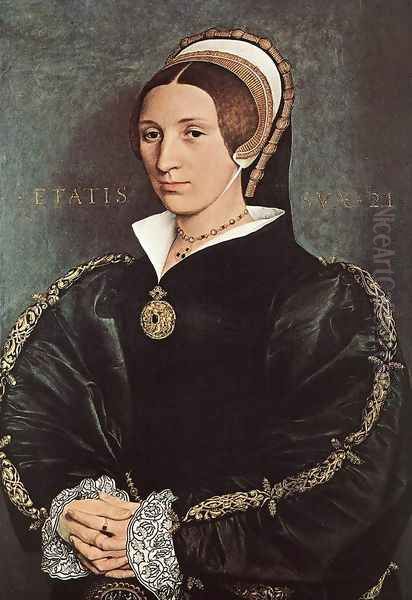
By the 1530s, Spanish work had begun to develop into more elaborate patterns and was applied across entire cuffs and collars. These designs were predominantly geometric, forming borders that reflect influences from Greek, Roman, and Moorish architecture and mosaic traditions. As Becky Hogg notes, white linen garments were “decorated with geometric patterns worked in a black double running stitch, which embroidered the reverse of the fabric as neatly as the front” (Hogg, 2011 p. 10). Embroiderers created these patterns by combining vertical, horizontal, and diagonal stitches of varying lengths or by altering the spacing between stitches.
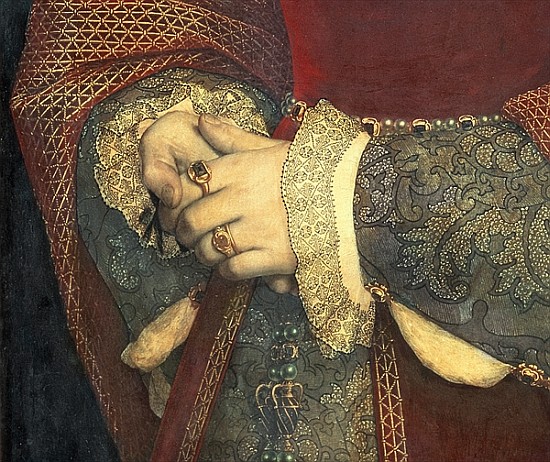
Detail from Holbein portrait of Jane Seymour
Kunsthistorisches Museum, Vienna painted in 1536
Catherine Howard by Holbein
National Portrait Gallery, Painted 1541
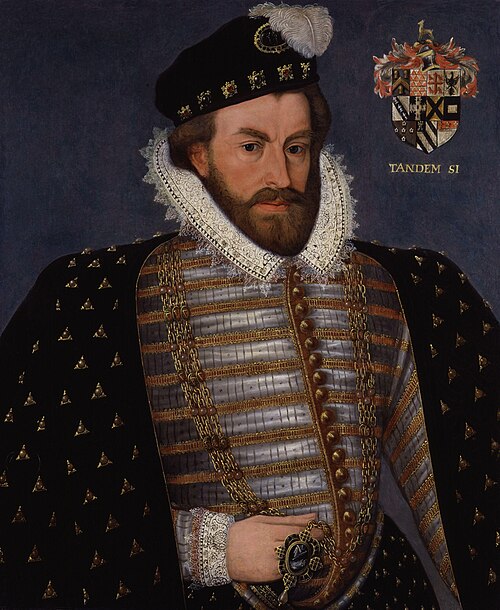
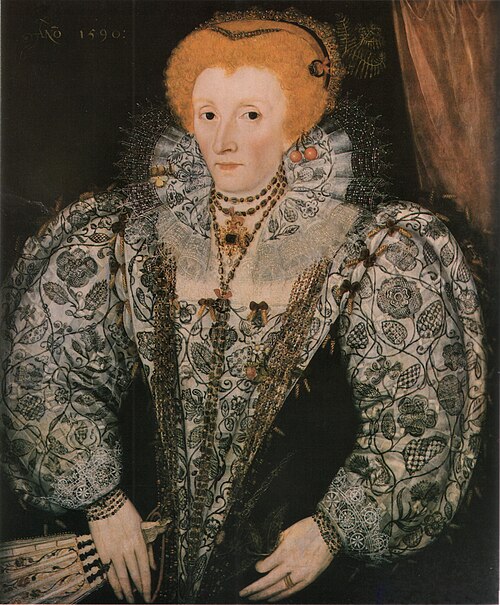
After the divorce of Henry VIII and Catherine of Aragon, the term Spanish work gradually shifted to blackwork, which is the term we still use today. Blackwork remained highly fashionable during Henry VIII’s reign and was used extensively on linen garments. Men’s shirts often featured intricate embroidery on the collars, ruffs, sleeves, and cuffs, while women’s chemises were decorated with blackwork on the wrist frills and the front panels of the garment. During the reign of Elizabeth I (1558–1603), the technique expanded even further, appearing on entire sleeves, jackets, smocks, and household textiles such as bed hangings and linens. It is in this period that blackwork developed into more complex, naturalistic designs featuring floral motifs with petals, leaves, and branching forms. Embroiderers of the Tudor era were also able to reproduce designs from pattern books using the “prick and pounce technique” (Pascoe, 1986, p. 17).
Sir Christopher Hatton
National Portrait Gallery, Unknown Artist, around 1589
Elizabeth I
Jesus College, Oxford, Unknown Artist 1590
Blackwork gradually declined between 1600 and 1630 and nearly disappeared altogether, as it was no longer used on clothing or household textiles throughout the 18th and 19th centuries. Although some of the traditional patterns survived, needlework during this period was typically executed in color rather than in black thread. At the beginning of the 20th century, blackwork experienced a revival, primarily in the form of household items such as cushion covers, napkins, and tablecloths. Embroiderers continued to uphold high standards of craftsmanship, and in keeping with earlier traditions, designs were carefully stitched to remain reversible, with no visible loose threads.
After the 1960s, blackwork shifted away from domestic textiles and clothing and became more commonly used for framed artwork and wall hangings. Traditional expectations also began to fade, and the style evolved toward a more expressive, dramatic aesthetic. While many of the historical patterns were still employed, reversibility was no longer essential, and the single‑thread technique gave way to the use of multiple threads. This allowed embroiderers to create areas of varying thickness, producing shading, and engraving‑like effects.
From the 1980s into the early 2000s, blackwork continued to develop as artists introduced color, texture, and tonal shading to create modern compositions such as landscapes rather than the earlier floral motifs, vine patterns, or reversible designs. Although the underlying patterns remained recognizable, embroiderers adopted a freer, more interpretive approach, resulting in contemporary works of art. Many of these pieces still relied primarily on black thread, but the subjects moved away from floral motifs to include landscapes, portraits, animals, and everyday objects.
Today, blackwork embroidery is still taught by the Royal School of Needlework in England through both stand alone courses and its bachelor’s degree program. Numerous books, patterns, and instructional materials are also available for beginners as well as advanced needle workers, ensuring that either the traditional or modern approach continues to evolve for a new generation of embroiderers.
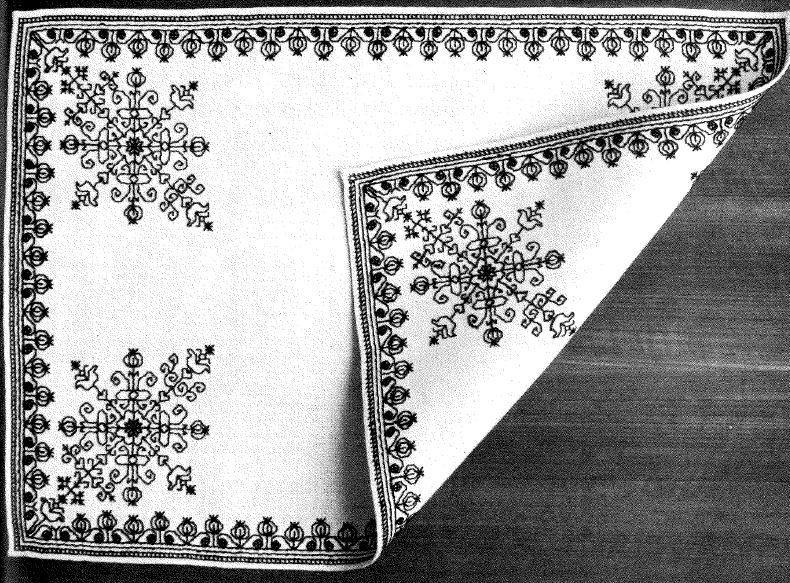
Above: Tray Cloth Embroidered by Olive Prior 1930
Pomegranate stitch around the border was very popular with Catherine of Aragon – (Pascoe, 1986, p. 23).
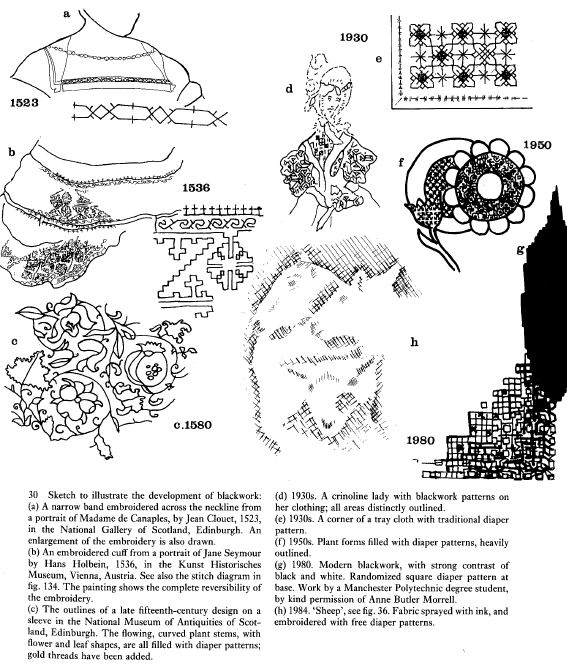
Right: The development of Blackwork since 1523 to 1980
(Pascoe, 1986, p. 31).
Blackwork Project
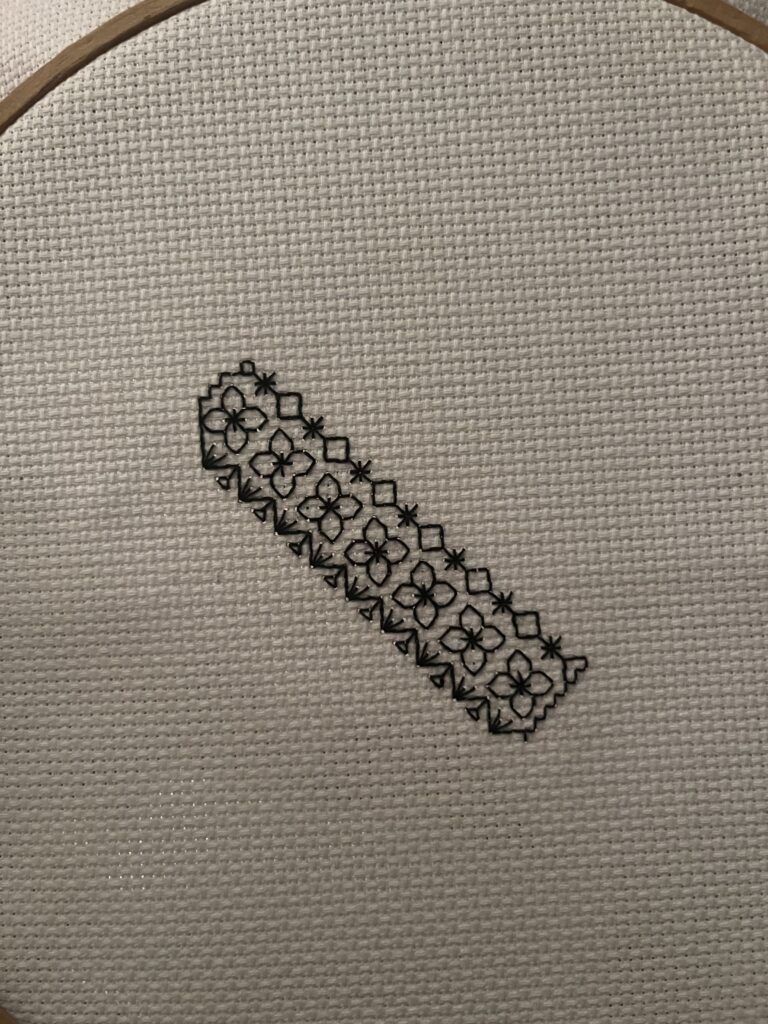
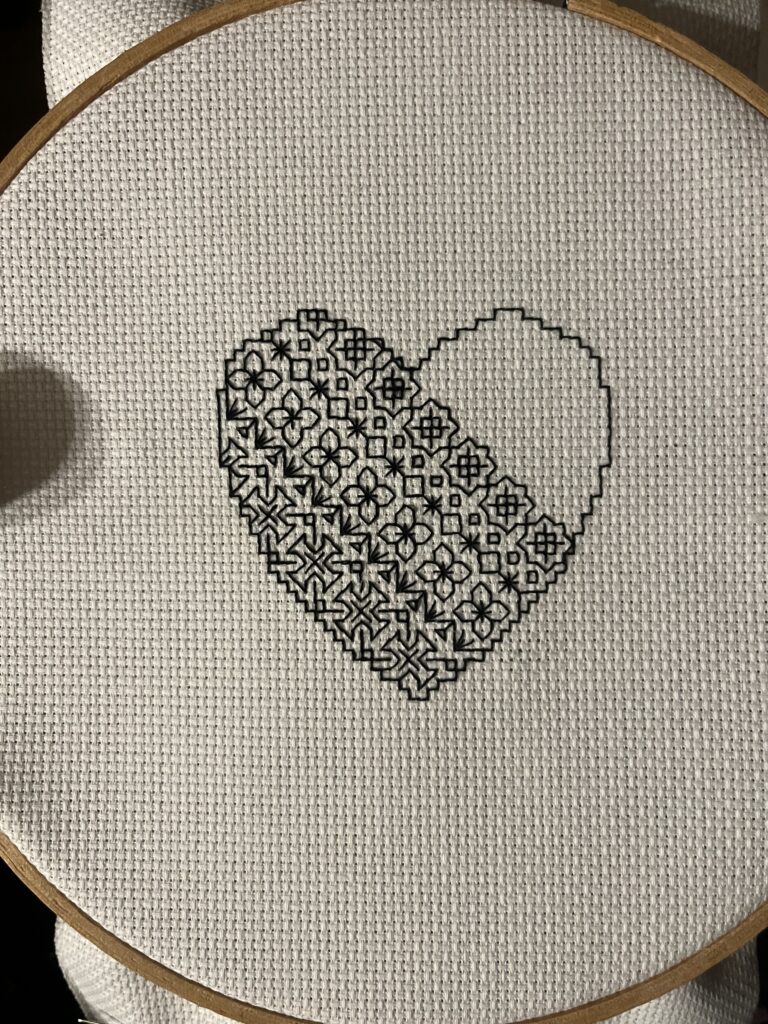
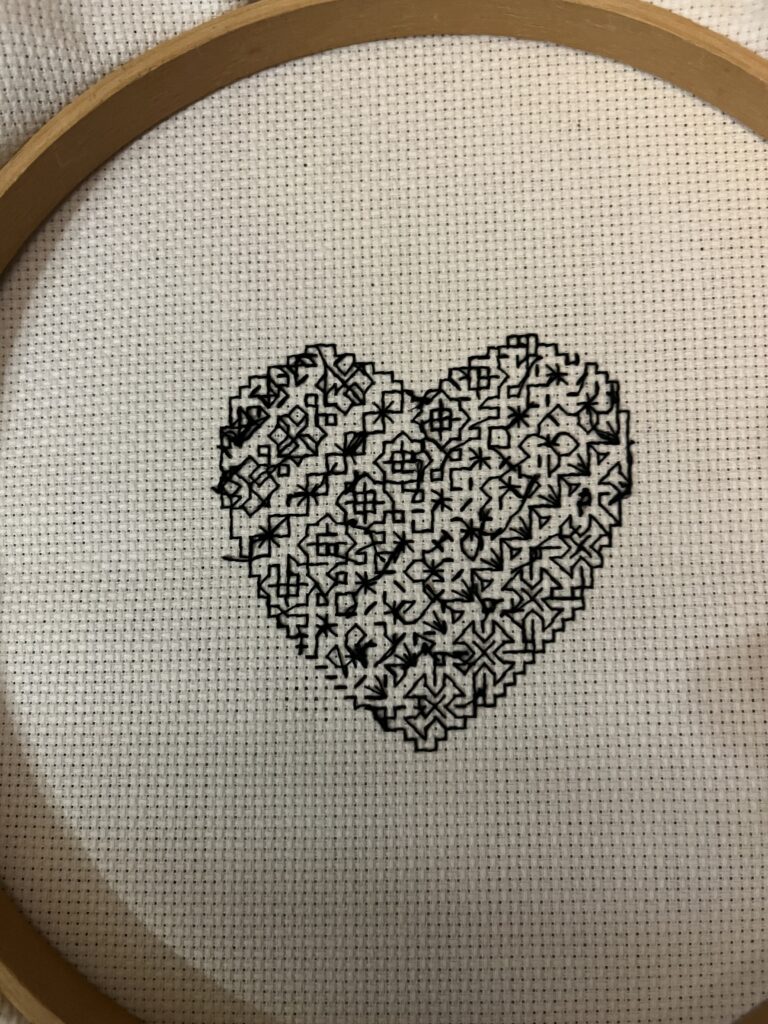
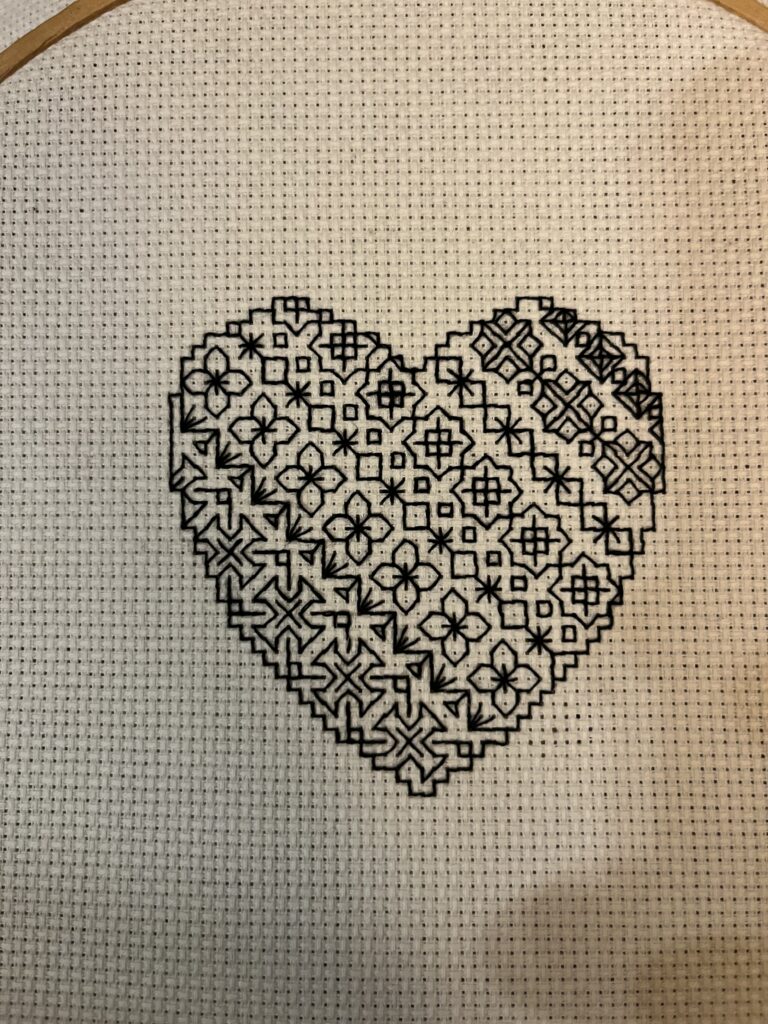
For my project this semester, I chose to complete a small blackwork embroidery piece incorporating several distinct patterned designs. My goal was to evaluate how effectively I could execute the traditional technique in producing an identical appearance on both the front and back of the cross-stitch fabric.
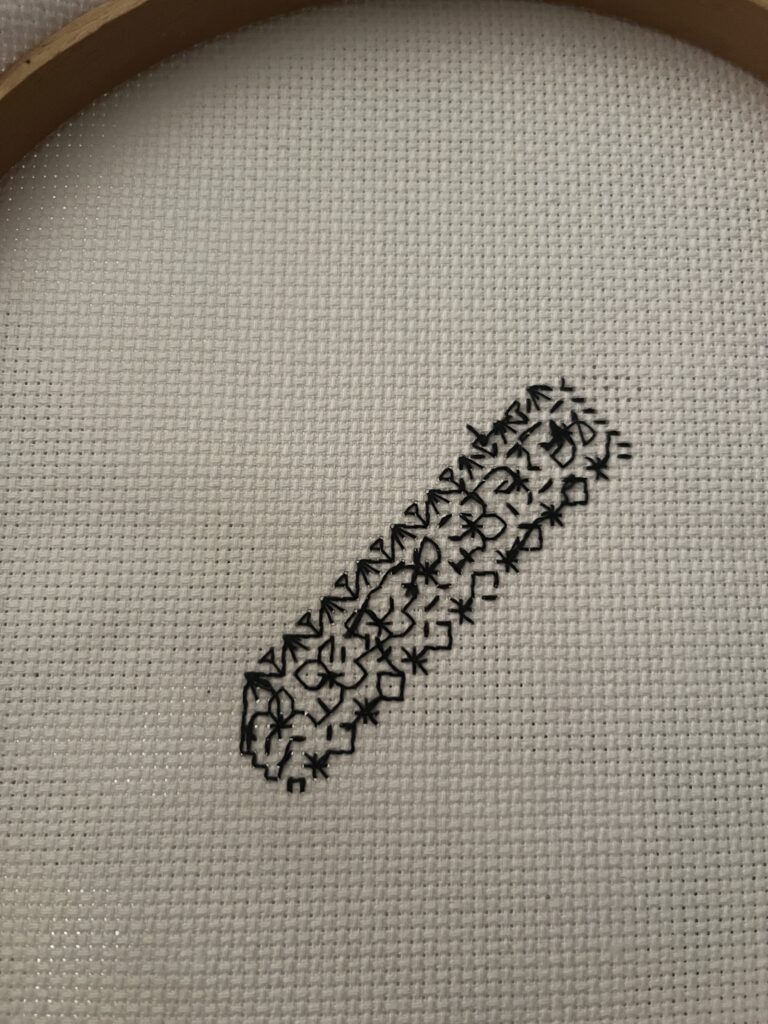
I found the hand‑embroidery process enjoyable, but achieving perfectly mirrored designs along with not having visible loose threads proved to be a challenge that I did not successfully execute. Some patterns were straightforward to reproduce on both sides, while others required considerable planning. At times, I needed to think 4-6 stitches ahead, but it was still a challenge to maintain symmetry on the reverse side. Despite these difficulties, I am very satisfied with the final result. This project has encouraged me to continue developing my skills in blackwork embroidery by experimenting with additional patterns and potentially designing original works of art in the future.
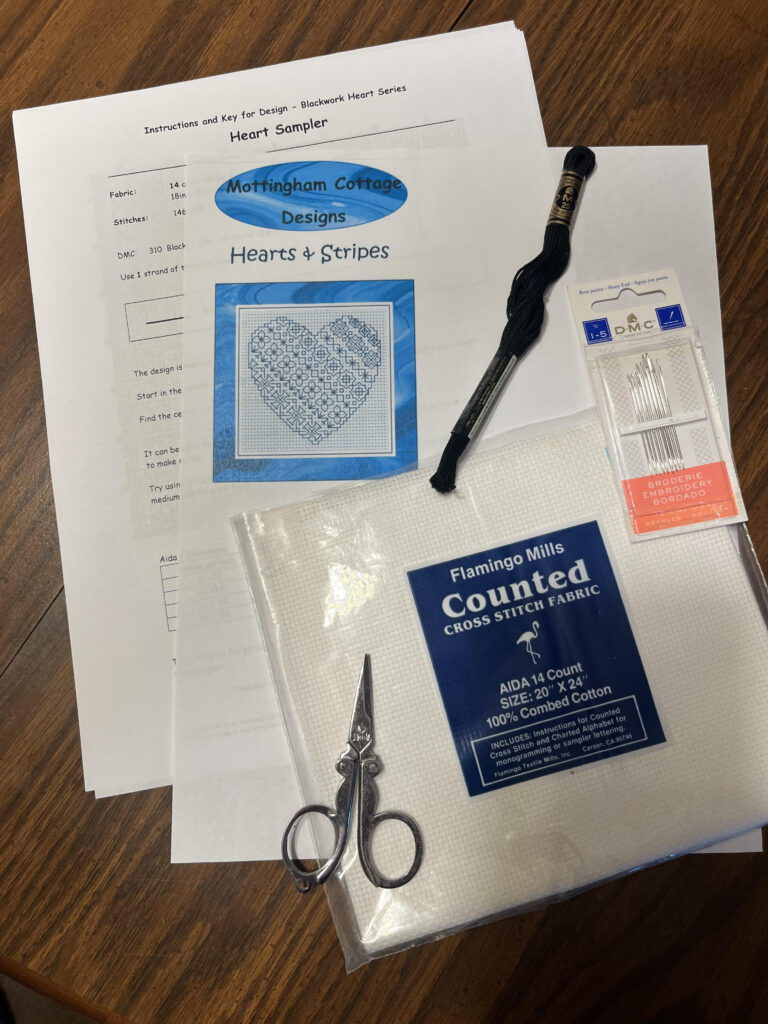
Supplies: Black embroidery thread, 14 count cotton cross-stitch fabric, needle, sciissors, design template
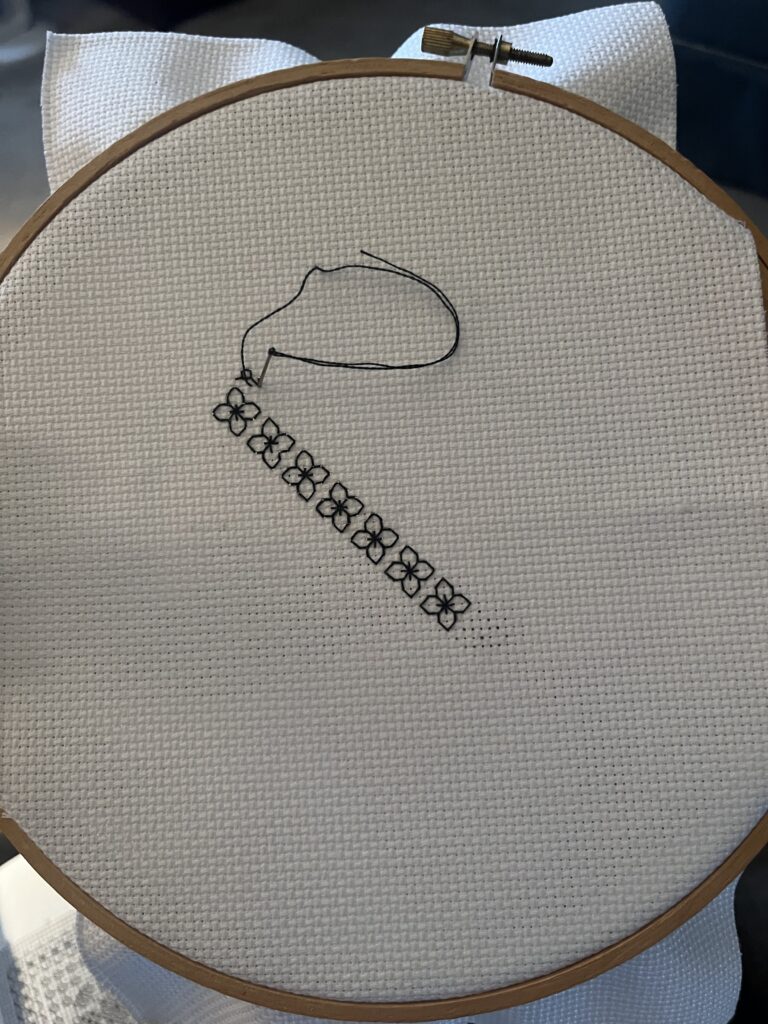
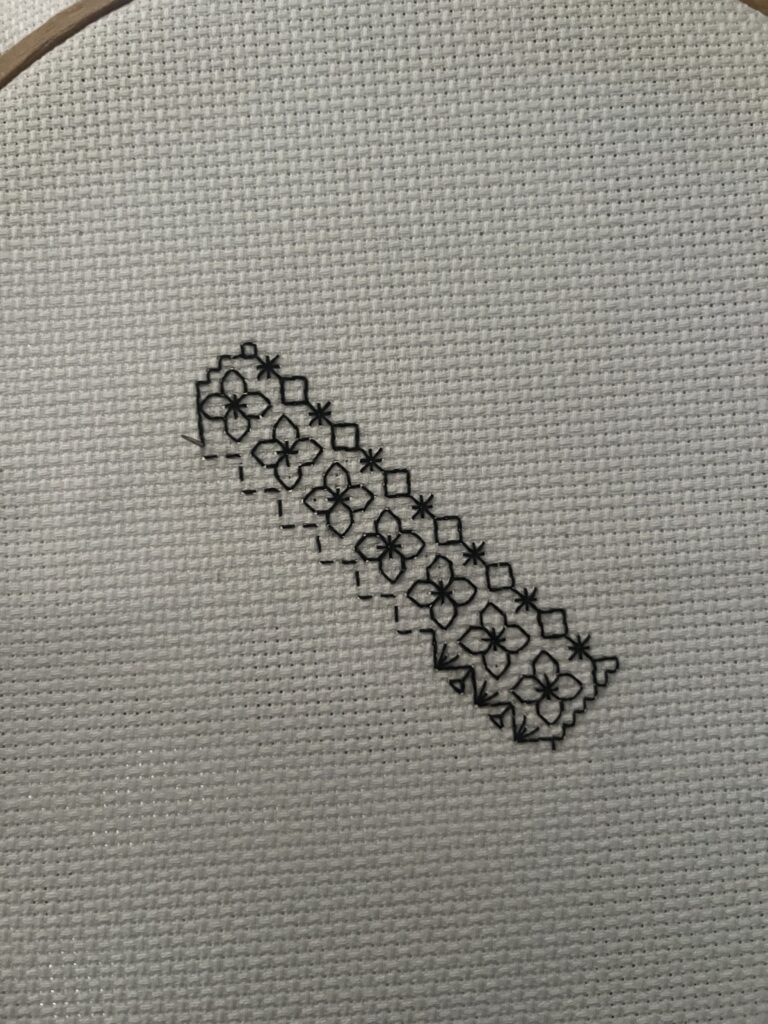
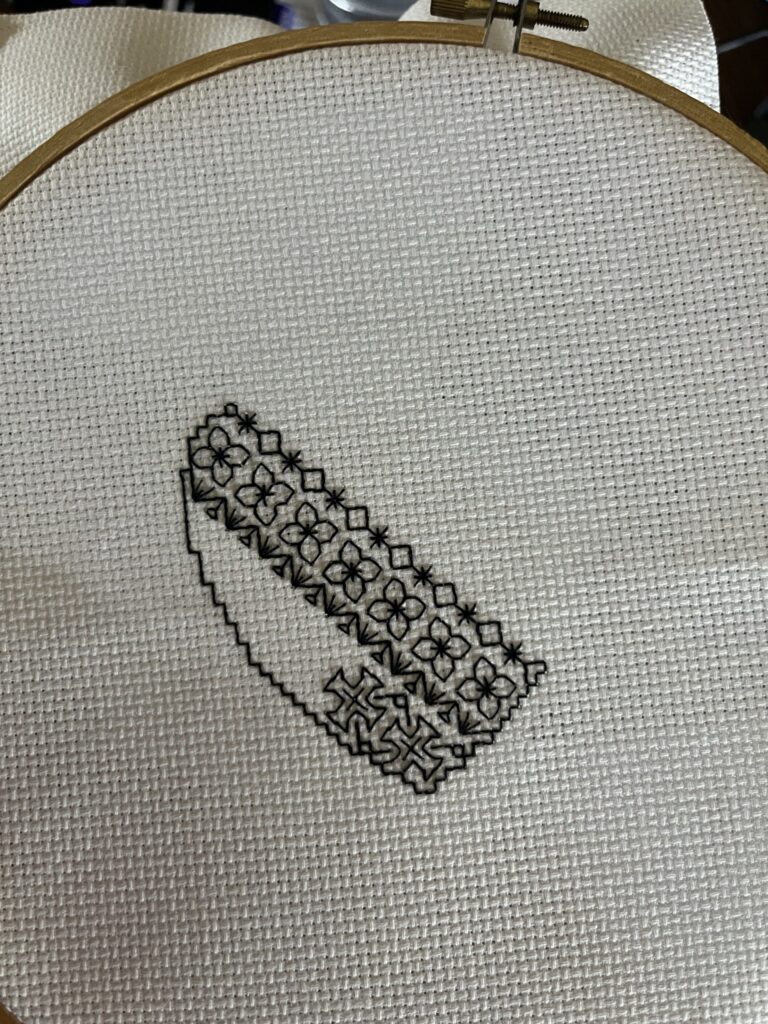
Started in almost the center of the design with a mosaic flower pattern – I did forget when I started embroidering to replicate the design on the back, as I automatically shifted to using the least amount of thread on the back.
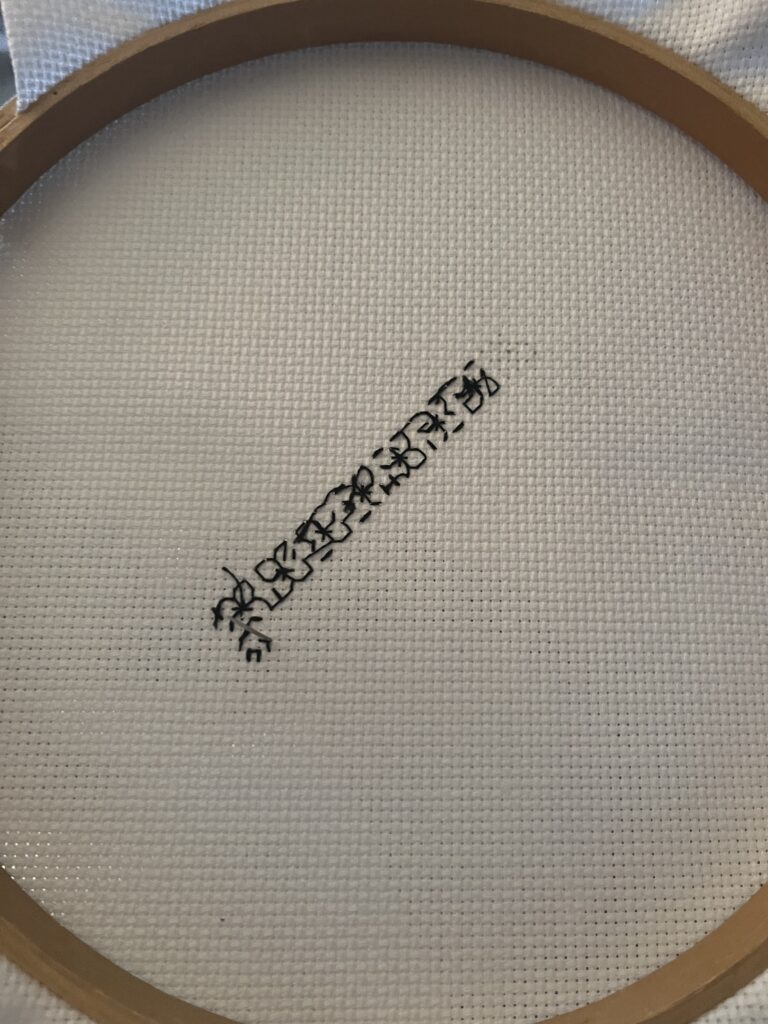
About halfway through this design, I tried to repeat the design on the back, but I really struggled with getting all the petals on the back and not overlapping my thread on the front.
In my research, embroiderers recommended skipping every other stitch and then coming back to fill in the stitches that were missed and this would fill in the design.
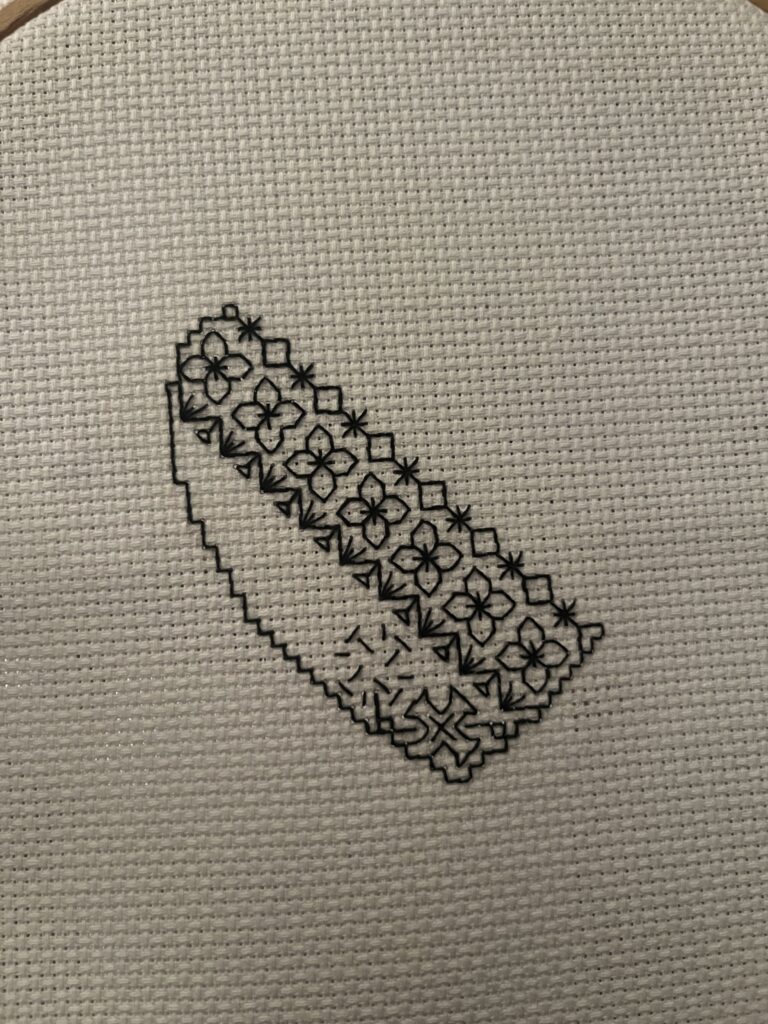
Using this technique the 2nd and 3rd design, repeating the pattern on the back was much easier.
Front of the design
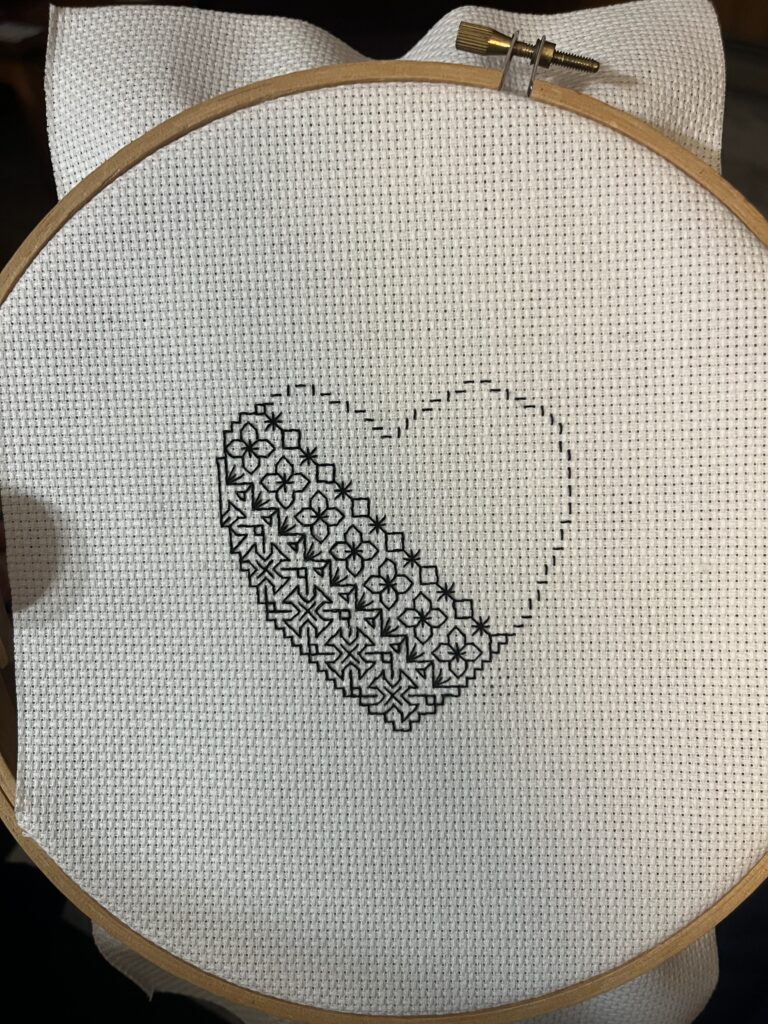
I continued this technique in the next design, which is similar to a Canterbury cross.
Finishing the 2nd cross
Stitching the outline of the heart
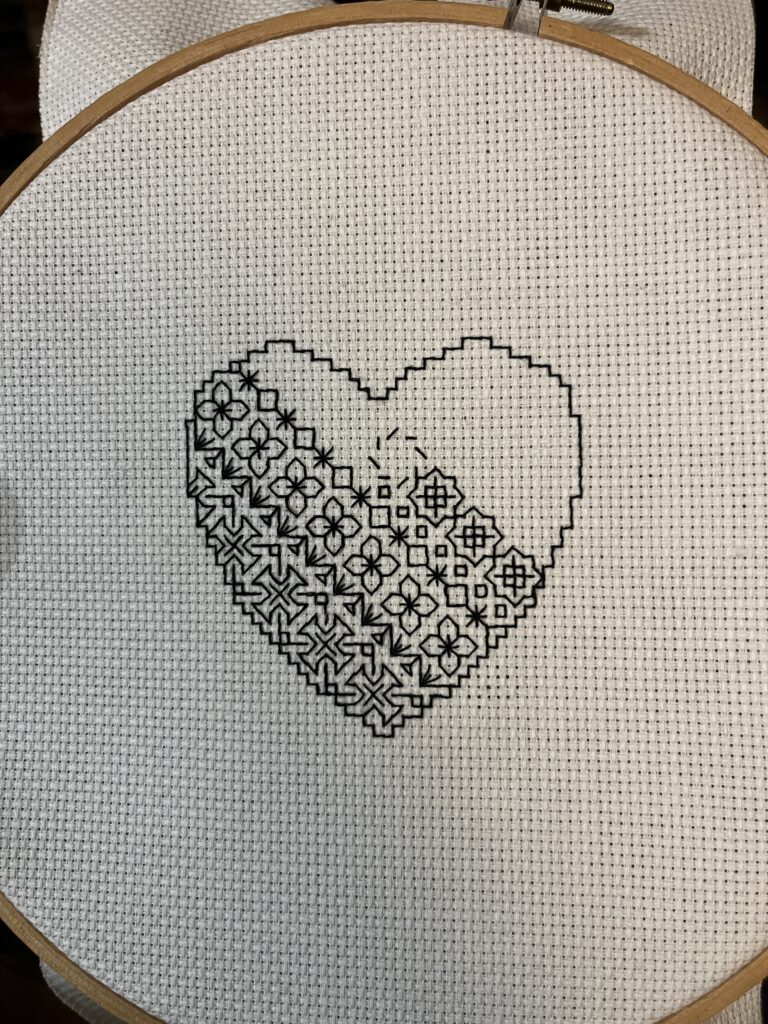
Continuing on with the same technique of every other stitch for the sixth design
Finished the 6th design which reminded me a mosaic tile work
Back of the finished design
Front of the Heart
References
Geddes, E., & McNeill, M. (1976) Blackwork Embroidery. Dover Publications, Inc.
Gostelow, M. (1998). Blackwork. Dover Publications.
Hogg, B. (2011). Blackwork.
Pascoe, M. (1986). Blackwork Embroidery. B T Batsford Limited.
Wilkins, L. (2020). Beginner’s Guide to Blackwork. SearchPress+ORM.